To evaluate a legal AI vendor, ask what work it completes, who checks the output, when a lawyer gets involved, how it handles your data and what you pay. Then test it on a real workflow. This legal AI vendor evaluation guide compares software, managed services and law firms, with Alaro's answer to each question.
Why do legal AI vendors sound similar?
Because much of the language is interchangeable: faster, smarter, secure, built for lawyers. The underlying systems, workflows and safeguards can still differ.
What differs is the job. Some vendors give your lawyers a better tool. Some take the work off your desk. A few say they'll take legal responsibility for it.
Those three offers can look similar in a 30-minute demo. Ask what the service actually includes before you buy, then test it on a representative workflow.
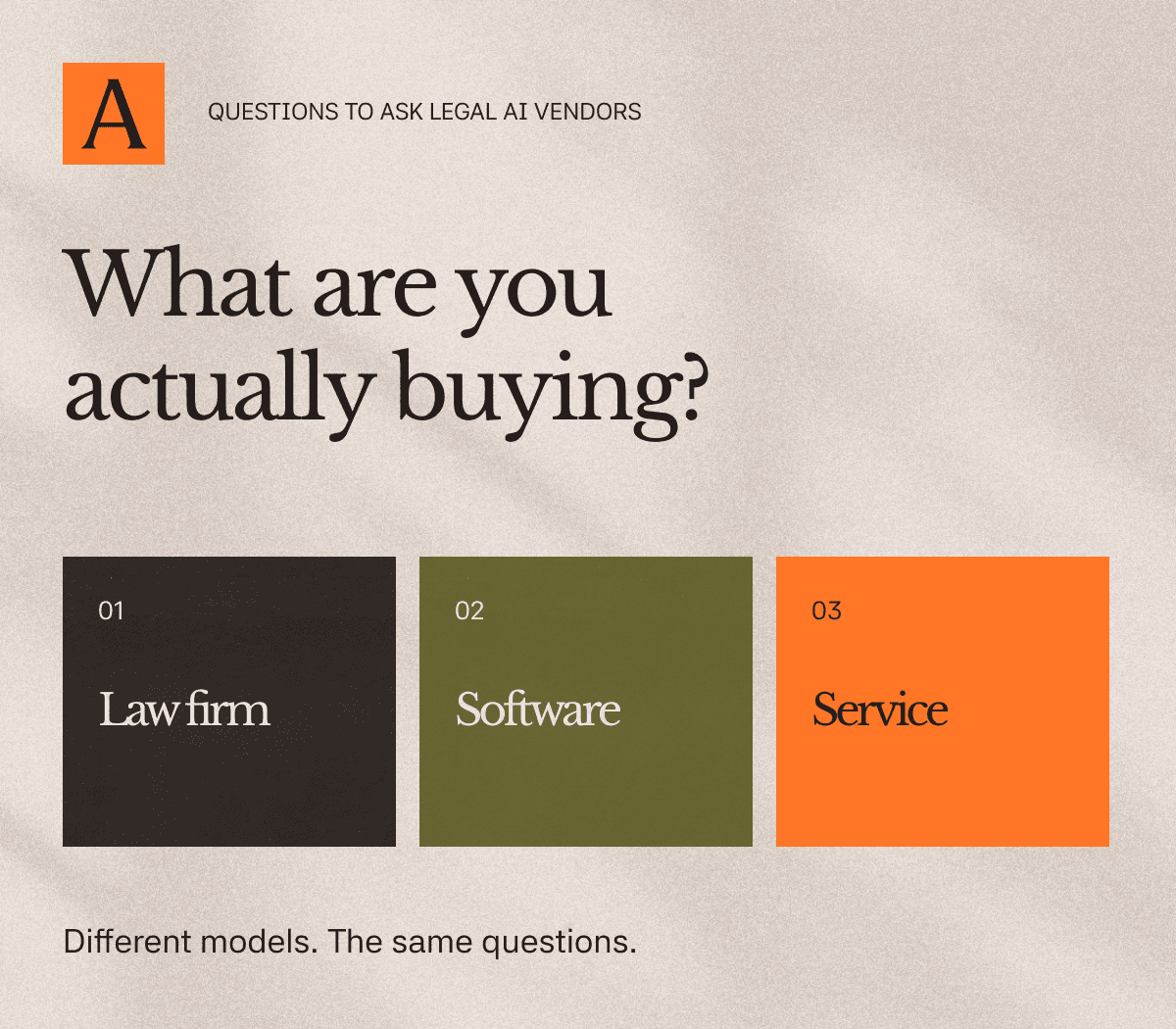
What are the main types of legal AI vendor?
Software (AI legal tools)
- What you buy: A license to a tool.
- Who does the work: Your lawyers, with AI help.
- Who checks the output: Your lawyers.
- Typical pricing: Per seat or per usage.
- Best for: Research and drafting your lawyers own.
Service (work done for you)
- What you buy: Work delivered to an agreed scope.
- Who does the work: The provider's people and systems.
- Who checks the output: Set by the agreement.
- Typical pricing: Per workflow, matter or volume.
- Best for: Recurring, well-defined work.
Law firm
- What you buy: Legal services under professional rules.
- Who does the work: The firm and its lawyers.
- Who checks the output: The firm's lawyers.
- Typical pricing: Hourly or per matter.
- Best for: Advice a lawyer must sign off.
These models can overlap. A provider may offer AI-led work and access to lawyers within the same service. What matters is which service you're using, what review is included and who is responsible for it.
What does the vendor actually do, end to end?
This is the question that cuts through the most noise. A faster first draft can save time, but checking, approvals and follow-through still count. Ask how much work remains with your team.
- Which steps does it handle? Drafting only, or intake, chasing, negotiation, signature and filing too?
- Where does a person step in, and whose person?
- What happens when a request is missing information? You want it to ask, not guess.
Alaro's answer: Alaro is an AI paralegal that follows work through within your playbook, asking before going beyond it. That includes gathering information, chasing approvals and keeping records current.
Who can send it work?
Most requests reach legal from sales, finance and operations. A tool only your lawyers can open won't catch them.
- Can the business send requests the way it already does?
- Which of our systems does it work with today, not on the roadmap?
Alaro's answer: Your team can send requests through email, Slack, Teams or WhatsApp. Alaro also connects with tools such as Salesforce and Outlook.
Who answers when the output is wrong?
Quality claims are only part of the picture. Ask who checks the work and what responsibility each party accepts.
Using AI does not remove a lawyer's professional duties. In the US, the American Bar Association's Formal Opinion 512 (July 2024) addresses competence, confidentiality, communication and fees. That is a separate question from what a vendor promises in its contract: ask who reviews the output, what responsibility they accept and which terms apply.
- What do your terms say about the output? Ask what you must check, what the vendor commits to and what happens if something goes wrong.
- What checks run on the work, and when does a lawyer review it?
- Is there a named person responsible for our account?
Alaro's answer: You can ask Alaro to bring in a specialist lawyer and coordinate the review. You approve the scope and fee first. Lawyer review is on request; an AI-generated output should not be assumed to have been checked by a lawyer.
AI can miss context, misunderstand instructions or produce plausible but incorrect answers. Ask how the service detects errors, flags uncertainty and routes exceptions. Automated checks, quality monitoring and a lawyer reviewing a particular matter are different safeguards.
How long until it's doing real work?
Weeks of onboarding and prompt training are a cost, even when the license looks cheap.
- Can we start on one live workflow? A short trial on real work tells you more than any demo.
- Who sets it up, and who trains it on our playbook?
Alaro's answer: Start by sending Alaro a task and a deadline through your preferred channel. It builds context from your preferences and playbooks as you work together.
How is it priced?
Per-seat pricing suits tools your lawyers operate. It sits awkwardly with AI that does the work, because the value is in what gets done.
- What unit am I paying for: seats, usage, matters or workflows?
- What happens when volume grows?
- What does the same work cost us today in outside-counsel fees or lawyer time? That's the real comparison.
Alaro's answer: You can try Alaro for free before choosing a paid option. If you request specialist lawyer review, you approve its scope and fee before it starts.
Where does our data go?
Start with these questions, then assess the provider against your organisation's security, confidentiality and data-protection requirements.
- Is our data used to train any model?
- Is it ever shared with other clients?
- Can we have it deleted when we leave?
Alaro's answer: Neither Alaro nor its model providers use your inputs or outputs for model training. Model providers operate under zero data retention agreements. You control retention and can export your data. See Alaro's Security & Trust page for the details.
Can we see it working for a team like ours?
A reference from a similar team helps you assess how the service performs beyond a demo.
- Who uses it today, at our size?
- If we leave, what do we take with us? Your playbooks, documents and history should be yours.
Alaro's answer: The Dominus case study shows how Alaro supports a real estate business with its legal work. Alaro's Security & Trust page also explains data export and what happens to your data when you stop using the service.
When do you need a different level of support?
- You need one-off, high-stakes advice. Ask for a specialist lawyer to review the matter, through Alaro or your own counsel, and agree the scope before relying on the work.
- Your legal work is mostly bespoke, with few recurring patterns to build a playbook around.
FAQ
Is an AI legal tool the same as a law firm?
No. An AI tool and a legal engagement are different things, even when one provider offers both. Ask whether you're receiving AI-generated work or advice reviewed by a lawyer, and what terms apply.
What is the most important question to ask an AI legal vendor?
Ask what work the vendor completes end to end, what checks it applies and when a lawyer reviews the output. Then compare data handling, total cost and performance on a representative task from your own business.
Is there an AI paralegal I can just email work to?
Yes. Alaro takes requests by email, Slack, Teams or WhatsApp and works through tasks within your agreed playbook, asking before going beyond it. See alaro.ai.
What is an AI paralegal?
An AI paralegal handles recurring legal tasks and the coordination around them, within agreed instructions. It can draft, gather information and follow up, but its output is not automatically lawyer-reviewed advice.